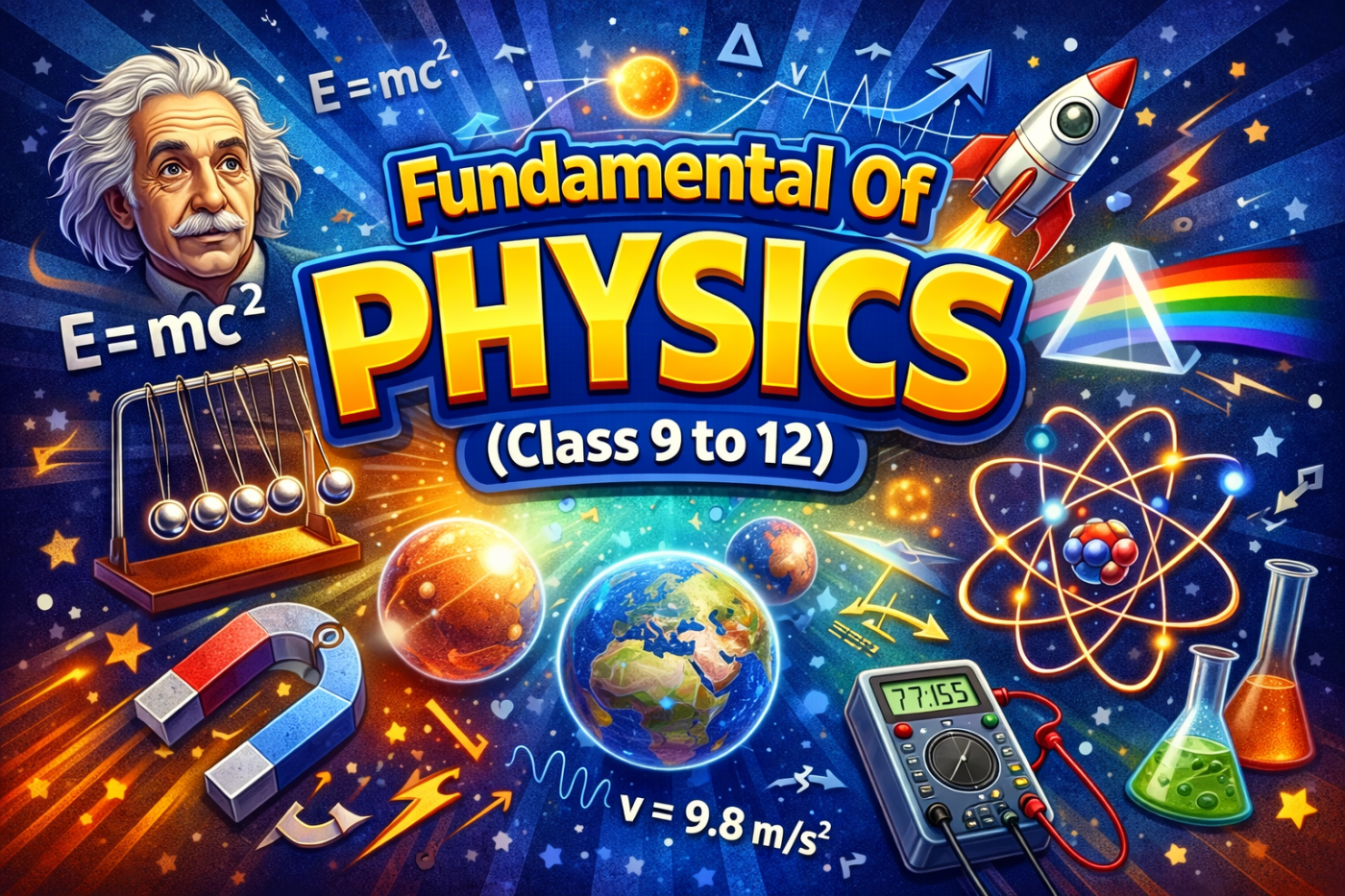

Fundamental Of Physics (Class 9 to 12)

Physics is the science that studies matter, energy, motion, and forces, and how they interact in the universe. It explains everyday phenomena like movement, hea...

Reviewed

Last updated at: 10 Apr 2026

0

... English
... Certificate Course
... 4 Students
... 00h 00m

Course Overview

1. What is Physics?

Physics is the study of matter, energy, space, and time, and how they interact.

At its core, physics tries to answer:

  • Why do objects move?

  • What is energy?

  • How does the universe work?


2. Measurement & Units (Foundation of Everything)

Physics depends on precise measurement.

SI Base Units:

  • Length → meter (m)

  • Mass → kilogram (kg)

  • Time → second (s)

  • Temperature → kelvin (K)

  • Electric current → ampere (A)

👉 Everything else (velocity, force, energy) is built from these.


3. Kinematics (Motion Without Causes)

Describes how objects move.

Key quantities:

  • Displacement (distance with direction)

  • Velocity = change in displacement / time

  • Acceleration = change in velocity / time

Key equations (constant acceleration):

  • v = u + at

  • s = ut + ½at²

  • v² = u² + 2as


4. Dynamics (Why Objects Move)

Explains motion using forces.

Newton’s Laws:

  1. Inertia: Objects resist changes in motion

  2. F = ma: Force = mass × acceleration

  3. Action–reaction: Every action has an equal and opposite reaction


5. Work, Energy, and Power

Work:

Work = Force × distance
(only when force causes movement)

Energy:

Capacity to do work
Types:

  • Kinetic (motion)

  • Potential (position)

Law of Conservation of Energy:

Energy cannot be created or destroyed—only transformed.

Power:

Rate of doing work
Power = Work / time


6. Momentum

Momentum = mass × velocity

Key principle:

Conservation of momentum
(total momentum stays constant in a closed system)


7. Waves & Oscillations

Wave types:

  • Mechanical (sound)

  • Electromagnetic (light)

Important terms:

  • Wavelength

  • Frequency

  • Speed = frequency × wavelength


8. Thermodynamics (Heat & Energy Transfer)

Key ideas:

  • Heat flows from hot → cold

  • Temperature measures average kinetic energy

Laws:

  1. Energy is conserved

  2. Entropy (disorder) increases


9. Electricity & Magnetism

Basic quantities:

  • Charge

  • Current

  • Voltage

  • Resistance

Ohm’s Law:

V = IR

Magnetism:

Moving charges create magnetic fields.


10. Modern Physics (Advanced but Important)

Includes:

  • Quantum mechanics (very small scale)

  • Relativity (very fast / massive objects)

Famous ideas:

  • E = mc² (mass–energy equivalence)

  • Wave–particle duality


🧠 How to Study Physics Effectively

  1. Understand concepts first, then formulas

  2. Practice solving problems

  3. Visualize real-life examples

  4. Focus on “why,” not just “how”

See More

FAQ

FAQ area empty

Course curriculum

Requirment

Outcomes

Instructor

...
Bedanidhi Bhandari

0.0

  • ... 4 Students
  • ... 2 Courses
  • ... 0 Review

View Details

Reviews

Rate this course :

Remove all
...

Free

... Enroll Now
  • ...

    Students

    4
  • ...

    language

    English
  • ...

    Duration

    00h 00m
  • Level

    intermediate
  • ...

    Expiry period

    1 Months
  • ...

    Certificate

    Yes
  • gi
  • Last updated

    10 Apr 2026
  • Reviewed
Share :